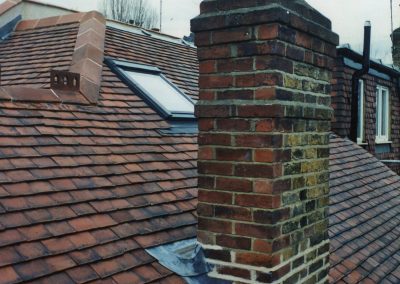
Clay Plain Tiles
London roofers used Clay Plain Tiles and Welsh slate in the early 20th century. Oftentimes, roofers are reluctant to reuse old slate regardless of how well-maintained it is. However, clay plain tiles are another matter entirely.
So, why the wariness about using the client’s original slate? There are several key reasons for this. Firstly, the difficulty of removal from the old battening without splitting it. In addition, it requires a further two holes punched into the surface.
As a reference, the existing ones will inevitably be too large. Hence, there is little chance of knowing how much material is recoverable. Furthermore, second-hand alternatives tend to be mediocre and very over-priced.
However, clay plain tiles present a very different situation. Namely, the majority are not nailed into position. Instead, they are hung by lugs from the roof batons. Therefore, no damage occurs in their removal.
Additionally, an experienced eye can judge the percentage of recoverable tiles. This is achieved by putting a ladder on the property’s guttering. From there, closely inspecting the roof flanks from below would be the next step.
What is the reason for this? The roofer is looking for evidence of frost damage. For the most part, frost-damaged tiles delaminate from the bottom rather than the top service. In the winter, margins underneath the tiles become wet as rain cascades down the roof. As a result, it fans out and spreads 2 or 3 centimetres as it reaches the bottom edge.
Whereas the top surface may dry off in the wind, the underside remains wet. Hard frost attacks the moistened surface. Poor quality clay or the firing of the tiles not being thorough results in ice pushing off the face of the material. This exposes its delicate centre.
Once this happens, the tile is compromised and rapidly disintegrates from the bottom up. Tiles viewed from the road may appear intact. On closer inspection, a proper estimation of recoverable material may be achieved. However, frost-damaged tiles appear as a fragile delaminated shell.
If cleaned with a caustic solution and wire brush, clay plain tiles will be good as new. Good quality second-hand machine-made Rosemary or Acme plain tiles are readily available. They can often be found in most roofing or architectural salvage yards. There can be a shortfall of tiles through frost damage or breakages. However, a roofer would have little difficulty finding replacements.
What can be done by reusing the client’s own tiles? Here is a roof that at first glance was a complete write-off. The badly maintained zinc valley at the front was a mess. Additionally, the left-hand party wall was leaking and falling apart. Meanwhile, the plain tiles were of superb quality.
We encouraged the client to let us clean and reuse them. This was in conjunction with second-hand valley tiles which we knew were available. The photographs before and after show what can be achieved using a little imagination. There was also a lot of enthusiasm, much of which stemmed from a grateful client.
Before

AFTER